LOW COST HONG KONG LEGAL SERVICE

YIP, TSE & TANG, HONG KONG LAWYERS

  • HONG KONG LEGAL SERVICES
    Yip, Tse & Tang, Hong Kong Lawyers: Low-cost Speedy Hong Kong Legal Services
    Head of Matrimonial Department: Polly Hui: Divorce, Custody, Maintenance
    Senior Partner:Thomas Tse<: Wedding Civil Celebrant, Properties Sale and Purchase, Mortgages
    Managing Partner:Charles Tse: Employees' Compensation Claims, Personal Injuries
    Partner: Bankruptcy, Divorce, Deed Poll
    Partner: Bankruptcy, Divorce, Deed Poll
Traffic

  • Visits

Certificate Repository

Certificate Internal Database is a database to keep track of the pending certificate request, issued or revoked certificate, private Certificate Revocation List (CRL), etc. Only RA and CA have the rights to update this database. A web user interface will be provided for users to query the status of their certificate requests and any issued or revoked certificate. Various fields in certificate, such as serial no, expiry date, subject name, etc will be indexed. This will allow faster queries based on these standard attributes.

A high performance directory server, based on the IETF LDAP standard, is used as a public repository of Certificate Revocation List (CRL), user and CA certificates. Its design is based on the RFC 2587 schema. A standard LDAP interface will be provided to native client for retrieving certificate for applications like S/MIME or SSL client authentication.

Concept of Public Key Infrastructure (PKI)

PKI covers the use of public key cryptography for authentication and access control of a user, guaranteeing the integrity and non-repudiation of documents signed by the user, and confidentiality of data.
PKI employs a pair of keys for each user: a private key which is known only to the user himself, and a public key which is published by some authority, in the form of a digital certificate (certificate for short).

In signing a document or an e-mail, a user signs using his own private key so that others can use the signer's public key to verify the authenticity and non-repudiation of documents or e-mail. Since only the user has his own private key to sign, non-repudiation is established.

Before sending an encrypted e-mail to a receiver, the sender installs the receiver's certificate in the sender's e-mail program which supports the use of PKI technologies. The program can, on the sender's instruction, encrypt an e-mail using the receiver's public key. The receiver, on receiving the encrypted mail, can use his private key to decrypt the mail. Since only the receiver has his own private key, the encrypted mail will only be readable by him. Others, even if they can get hold of a copy of the encrypted mail over the network, would not be able to read the encrypted mail as they do not have the receiver's private key to decrypt the mail. The use of PKI saves the trouble of maintaining and distributing the same encryption/decryption key between the sender and the receiver.

The e-mail program Netscape Messenger v4.7x supports the signing and encryption of e-mail using 1024-bit RSA keys and certificates.

By using strong public key cryptographic algorithms, such as 1024-bit RSA keys which the HKU CA and Hongkong Post are employing, it is practically impossible for anyone to crack the private key from the public key within the life-time of a private key.

HKU Certification Authority (HKUCA)

HKU Certification Authority (HKUCA), run by the HKU Computer Centre, set up public key infrastructure (PKI) to issue HKU digital certificates (HKU-Cert) from 22nd September 2000 to current HKU staff and students (HKU members).

Personal: the HKU-Cert of a HKU member serves as his digital identity for him to authenticate himself and sign electronically in using HKU Electronic Services Delivery (HKUESD) of digital signature applications.

Server: from 1st February 2002, HKUCA also issues HKU-Cert (Server) to administrators of computer servers approved by HKUCA. The server named in a HKU-Cert (Server) can use the certificate in applications employing Secure Socket Layer (SSL) encryption.

According to the University, HKUCA is not seeking Recognized CA status, as defined in the Electronic Transactions Ordinance, from the Director of Information Technology Services Department of the HK SAR Government. Therefore, HKUCA is not subject to the governing rules and regulations set out in the Electronic Transactions Ordinance.

Provisions as to confidential disclosure, etc.

An application for the registration of a design shall not be refused, and the registration of a design shall not be invalidated, by reason only of:
(a) the disclosure of the design by the owner to any other person in such circumstances as would make it contrary to good faith for that other person to use or publish the design;

(b) the disclosure of the design in breach of good faith by any person other than the owner of the design;

(c) in the case of a new or original textile design intended for registration, the acceptance of a first and confidential order for goods bearing the design; or

(d) the communication of the design by the owner to a government department or to any person authorized by a government department to consider the merits of the design, or of anything done in consequence of such a communication.

An application for the registration of a design shall not be refused, and the registration of a design shall not be invalidated, by reason only:

(a) that a representation of the design, or any article to which the design has been applied, has been displayed, with the consent of the owner of the design, at an official international exhibition;

(b) that after any such display as is mentioned in paragraph (a), and during the period of the exhibition, a representation of the design, or any article to which the design has been applied, has been displayed by any person without the consent of the owner; or

(c) that a representation of the design has been published in consequence of any such display as is mentioned in paragraph (a), if the application for registration of the design is made not later than 6
months after the opening of the exhibition.

Here, "official international exhibition" (正式國際展覽) means an official, or officially recognized, international exhibition falling within the terms of the Convention on International Exhibitions signed at Paris on 22 November 1928, and any protocols to that Convention, as revised or amended from time to time.

Computer programs, protected layout-designs (topographies) and designs for articles of a primarily literary or artistic character

Computer programs and protected layout-designs (topographies) are not registrable.

Provision may be made by rules for excluding from registration under this Ordinance designs for such articles of a primarily literary or artistic character as the rules may specify.

Designs contrary to public order ("ordre public") or morality are not registrable

A design the publication or use of which would be contrary to public order ("ordre public") or morality is
not registrable.

The publication or use of a design shall not be considered to be contrary to public order ("ordre public") merely because it is prohibited by any law in force in Hong Kong.

Designs are not registrable if appearance of article is not material

A design is not registrable in respect of an article if the appearance of the article is not material, that is, if aesthetic considerations are not normally taken into account to a material extent by persons acquiring or using articles of that description, and would not be so taken into account if the design were to be applied to the article.

Registrable designs

A design which is new may, upon application by the person claiming to be the owner, be registered in respect of any article or set of articles specified in the application.

A design for which an application for registration is made shall not be regarded as new if it is the same as:

(a) a design that has been registered in pursuance of a prior application, whether or not that design has been registered in respect of the same article for which the application is made or in respect of any other article; or

(b) a design that has been published in Hong Kong or elsewhere before the filing date of the application, whether or not that design has been published in respect of the same article for which the pplication is made or in respect of any other article, or if it differs from such a design only in immaterial details or in features which are variants commonly used in the trade.

The Registrar may, in such cases as may be prescribed, direct that for the purpose of deciding whether a design is new an application for registration shall be treated as made on a date earlier or later than that on which it was in fact made.

Defences to Product Liability

A defendant in a product liability action can raise many of the traditional tort defences.

A plaintiff's own negligence may reduce the potential damages based upon the degree of the plaintiff's comparative fault. That is the concept of contributory negligence.

If a person knowingly and unreasonably assumes the risk of a known danger, the manufacturer cannot be liable for the injuries that result. Thus, a person who intentionally pointed the laser beam to his eye and thereby hurt will not be able to recover injuries from the outlet maker. Some products, such new drugs like depressant, sex stimulant, may be dangerous, but not unreasonably so. To avoid liability, the dangers (such as side effect) should be made known to the public, and the seller clearly warns of the dangers, and properly packages and labels the product. Whether measures are adequate depend individual cases.

A manufacturer might also not be held liable if someone uses a product in an unforeseeable or unreasonable manner. For example, a person is injured on use of an electrical fan whose protective shield has been removed.

In cases of design defects, manufacturers may be able to escape liability on the basis of the "state of the art" defense, which asserts that the manufacturer has used the best available technology and design to make the product as safe as possible. If there is no safer known design, a manufacturer might not be liable for design defects. That is a matter of evidence that the manufacturer has to establish when defending his case.

Liable Parties in Product Liabiltiy

Generally, any person or entity in the chain of distribution can be liable for a defective product, including manufacturers, distributors, wholesalers and retailers.

香港法律熱門網站推介

  • 香港律師辦理分居離婚
    分居紙‧分居書‧分居協議書‧分居証明‧分居証明信
  • 1083 改名契
    改名‧改姓要先辦改名契,即.即取.即用改名契‧收費:$500‧辦公時間可直接前往各律師行,毋須預約。
  • 灣仔網站
    灣仔網站:集商業‧政務‧國際盛事‧消遣‧娛樂‧專業服務於一身
  • IVA債務重組、低息還債
    個人債務重組(IVA)、香港破產、個人自願安排、拯救個人破產、DRP、破產接管、收數公司滋擾、投訴收數公司滋擾
  • 遺產承辦、遺囑、立平安書、財產計劃
    遺產承辦、財產保障、財務策劃、遺產分配、離岸信託基金、遺囑、遺囑認證
  • 醫療疏忽索、診斷失誤償
    醫療疏忽索償網:醫管局、醫生、醫院失誤、病人權益、醫療失誤、專業疏忽賠償、診斷失誤
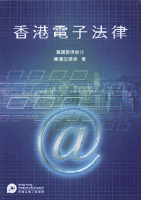
  • 香港電子法律書介
    電子交易、網址糾紛、電腦犯罪和保安、網上理財、個人資料私隱、電子証據、網上誹謗、互聯網下的版權和司法管轄權
  • 刑事辯護、求情和保釋法律服務
    刑事辯護、求情和保釋:打擔保(差館或法庭)、打甩口供紙、盤問証人、決定應否在庭作証、結案陳詞、案例考究、打甩控罪、獲得輕判
  • 按揭、物業轉按、物業加按、贖樓
    樓宇法律服務:樓宇買賣手續、物業按揭、按揭律師、聯名購買、物業轉按、物業加按、贖樓、居屋買賣、授權、政府收回土地、預售樓花
  • 離婚、撫養權、贍養費、財產分配
    離婚、撫養權、贍養費、財產分配、監護、分居
  • 8989 網上法律大全
    樓宇買賣、按揭、離婚、撫養權、贍養費、遺產承繼、遺囑工傷、職業病、交通傷亡、醫療失誤或疏忽、刑事辯護、保釋、求情、債務重組、IVA、DRP.破產、物業管理、知識產權
  • 法周刊
    刑事辯護、保釋、求情、債務重組、IVA、破產、離婚、撫養權、贍養費、遺產承繼、遺囑、知識產權、樓宇買賣、按揭、因工受傷、職業病、交通傷亡、醫療失誤或疏忽
  • 工傷索償、交通意外傷亡
    工傷索償、交通意外傷亡、人身傷亡、人身受傷:只代表傷者、不代表保險公司
  • 葉謝鄧律師行
    法律服務:債務重組(IVA.DRP)、個人破產申請、因工傷亡索償、車禍意外疏忽索償、醫療疏忽、遺囑、網上刑事罪行、遺產承辦、刑事辯護、刑事求情、保釋、按揭、轉按、贖契
  • 電子交易、網址糾紛、電腦犯罪
    電子交易、網址糾紛、電腦犯罪、保安、網上理財、個人資料私隱、電子証據、網上誹謗、互聯網版權、司法管轄權
  • 破產網
    香港破產、債務重組(IVA)、債務一筆清、個人自願安排、破產條例、分期還款

《香港電子法律》書介